
"We'll be stopping next month." — by the time that message arrives, the family has already decided. The choice to leave usually starts forming two to three months before notice is given, and whether you can pick up the signals during that window largely determines your retention. This article covers the real reasons families leave, the five signs that start showing up three months out, the ideal contact frequency for students and parents, and six recurring-touchpoint templates that prevent drop-out before it happens.
The Real Reasons Behind Drop-Out — Stated vs. Actual
The reasons parents give for leaving tend to top out at "grades didn't improve," "cost," and "distance." But what many independent center owners observe in practice is that these are often the polite, surface reasons.
#1 — Fit with the tutor is, in reality, usually rooted in an information gap: the parent was never told how their child was actually doing. #2 — Grades aren't improving is often a perception gap — the student is in fact improving, but the change was never put into words and shared. #3 — Too expensive usually comes from a failure to communicate the value of the lessons regularly. #4, distance, is an environmental factor that's harder to prevent, though switches often happen when a competing center opens nearby. #5, falling motivation, becomes hard to address if you miss that parents and students are driven by different things (parents want results; students care about the tutor and their friends).
In other words, a sizeable share of the top three reasons can be prevented by the quality and frequency of your communication.
5 Signs That Show Up Three Months Before Drop-Out
A withdrawal notice can feel sudden, but in most cases several signs appear beforehand. Simply getting into the habit of checking these five each month creates the chance to act early.
Sign 1: Attendance under 80% for two months running
Attendance is the most objective signal. A single off month happens (illness and so on), but when it dips below 80% two months in a row, treat it as a sign that motivation to attend is fading. Moving attendance into a digital tool lets you see this figure in real time.
Sign 2: Reschedule reasons turn vague
Watch out when "something came up" or "we're busy" start replacing specific reasons. A parent who used to give concrete reasons (another lesson, a doctor's visit) shifting to vague ones can signal that their engagement with the center is dropping.
Sign 3: Parents keep putting off meetings
When "maybe next time" or "I'm too busy" become the pattern, the will to actively keep the relationship going may be thinning. Once meetings start getting deferred, offering several time slots to make it easy to choose works well.
Sign 4: A first-ever late payment
When a previously reliable parent starts paying late, it can signal a change in their circumstances or a drop in the center's priority. It won't lead straight to withdrawal, but when it overlaps with other signs, follow up early.
Sign 5: Talk of a sibling joining suddenly stops
If a parent who was considering enrolling a sibling abruptly drops the subject, take note. A satisfied family naturally raises "the younger one too"; when that thread goes quiet, dissatisfaction with the current experience may be forming.
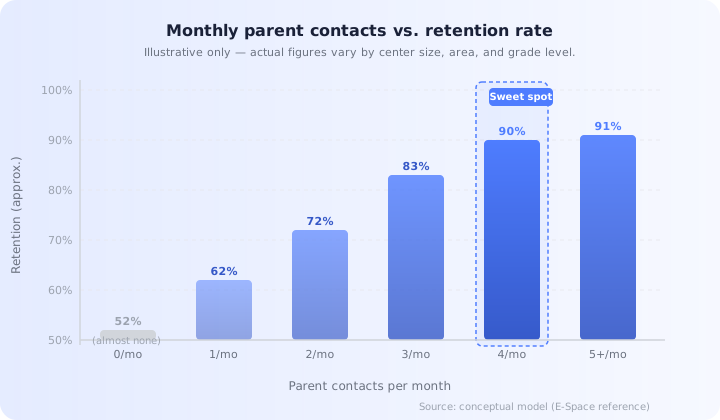 Monthly contacts vs. retention (illustrative) — about four a month is the sweet spot
The Golden Ratio for Contact — Designing Audience, Frequency, and Channel
Adding touchpoints matters, but over-messaging backfires. A center that sends something nearly every week can come across as noisy. As a field rule of thumb, automated alerts and broadcast messages to parents top out at around three to four a month. Beyond that, open rates fall and you risk eroding trust.
Use the table below as a baseline for designing touchpoints.
| Audience | Frequency | Channel |
|---|---|---|
| Student | End of every lesson | Verbal feedback (1 min) |
| Parent | Once a month | In-app chat progress note |
| Parent | Once a term | In-person or 30-min online meeting |
| Everyone | Each season (4×/year) | Summer / winter / spring course notices |
| If absences pile up | Same day after 2 in a row | Chat or phone follow-up |
In the Tokyo coding school case study, combining monthly progress chats with per-term meetings led to more parents saying "I finally understand how my child is doing."
Switching from a consumer messaging app to a dedicated center app keeps a record of every message and adds read receipts, so touchpoints are tracked more accurately (see also parent communication beyond LINE).
6 Templates to Systematize Your Touchpoints
Deciding to "communicate more" falls apart against the daily grind of running lessons. The core of improving retention is systematizing it — deciding the timing and wording in advance. Running just these six on a regular cadence changes the parent relationship dramatically.
Template 1: Birthday message
A single line on a birthday creates the feeling of "they remembered me." Don't overthink it — short is plenty.
Happy birthday, [Name]! We're cheering you on at the center as always — let's have a great month together.
Template 2: Exam-result check-in (within a week of the test)
After a regular exam, it matters to show you'll review the results together. Pair this with how to handle parents around mid-term exams.
Hope the mid-terms went well! How did they turn out? If you can share the scores, we'll factor them into how we run the next lessons. Let us know if anything's on your mind.
Template 3: Follow-up after consecutive absences (triggered by 2 in a row)
Two absences in a row is the moment that most needs early action. Reach out with care, not blame.
We noticed [Name] has been out the last couple of sessions — is everything okay health-wise? If something's come up, feel free to reach out and we can sort out make-ups together.
Template 4: New-term kickoff message
The start of a term is a prime moment when mindsets reset. Adding a nudge to set a goal helps lift motivation to attend.
A new term is underway! We'll be right behind [Name] to make it a productive one. If there's a goal for this term, we'd love to hear it!
Template 5: End-of-term meeting invite (with a booking link)
Meetings shouldn't be something you passively wait to be booked — proactively prompting them from the center side lifts the take-up rate.
We're holding end-of-term meetings. We'd love to talk through your child's progress and the plan for next term. Pick a time that works for you using the link below.
Template 6: Referral request from graduating families
Parents of students who've graduated or finished a course are a valuable group who leave with goodwill intact. Asking for a referral at the right moment is a natural way to keep the relationship going.
We've loved watching [Name] grow since they joined. If you know any families looking for a center, we'd be grateful for an introduction. Thank you as always.
Combining App Alerts with In-Person Contact
App push notifications are convenient, but broadcast-style alerts have low open rates — and important information can go unseen while a parent quietly decides to leave. Lean only on in-person or phone contact, on the other hand, and the quality varies by whoever's handling it.
The ideal is a hybrid: deliver everyday information by app alert, and add in-person contact at key moments. Handle day-to-day updates in app chat, and run per-term meetings in person — that combination creates touchpoints that are complete without being overwhelming.
To say it again: over-sending alerts drives parents away. Aim for three to four a month, and each time ask whether there's a real reason to send.
How E-Space Helps: 4 Ways to Systematize Touchpoints
Actually running a retention touchpoint plan requires a tool where the information lives in one place. In E-Space, these features support the day-to-day work of improving retention.
- Chat. Per-student and per-parent chats with a saved history — solving the "where did I send that?" problem of managing things on a consumer app.
- Push notifications. Send lesson changes and announcements to everyone or to specific students; recipients open the app to confirm.
- Scheduling (meeting booking). Beyond managing lesson dates, set meeting slots as a schedule so parents can check availability right in the app.
- Attendance visibility. See attendance rates at a glance, so you can spot students dipping below 80% early and move to follow up.
Together, these make "who to contact, when, and how" far less dependent on any one person.
| Plan | Monthly | Notes |
|---|---|---|
| Free | ¥0 | Core features at no cost |
| Basic | ¥980 | For mid-sized centers |
| Premium | ¥4,980 | More capabilities |
| Unlimited | ¥9,800 | No limits |
Takeaway: Retention Comes Down to "Systematized Attention"
What prevents drop-out isn't lesson quality alone. What consistently ranks at the top is the parent's sense of whether "the center genuinely cares about my child" — and that feeling is built by the frequency and quality of communication.
But more is not always better. Keep the three-to-four-a-month ceiling in mind while reliably landing your messages at the birthday, post-exam, consecutive-absence, new-term, end-of-term, and graduation moments. Systematizing these six touchpoints alone raises the odds of heading off a meaningful share of drop-outs.
Start by reviewing your own center's touchpoint design and asking where contact is currently slipping through the cracks.