
"Only three weeks until mid-terms" — and the moment that registers, the requests start stacking up. Parents message about adding extra lesson slots. Students want to reserve the self-study room. Tutors need shift adjustments. And every change ripples into the ones around it.
In Japan, most public junior high schools hold mid-term exams in the last week of May or the first two weeks of June — a window that may be unfamiliar to readers outside the country. For tutoring centers (known in Japanese as juku), this creates a concentrated pressure period that rivals the summer rush in intensity, but without the runway to prepare. This article explains why June consistently stalls tutoring operations and lays out 4 concrete systems to get through it without burning out your team.
4 Structural Reasons June Becomes a Bottleneck
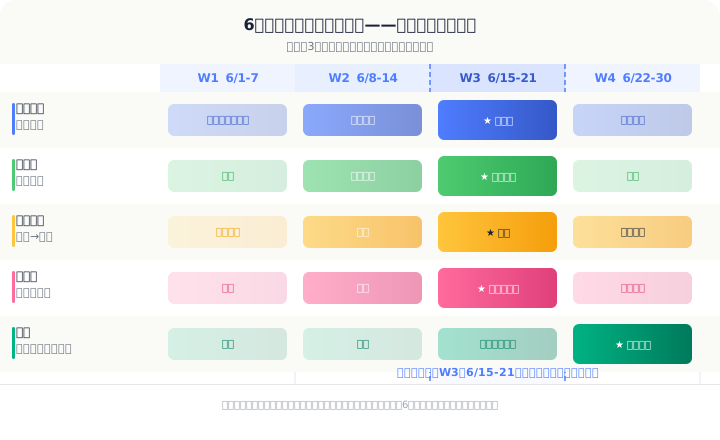 June workload structure: 5 operations converge during exam week (W3)
Extra lesson slots requested 2–3 weeks before the exam
Once students and parents lock in the exam date, the "can we add one more session?" requests follow within days. "We'd love help in English too" arrives shortly after. These requests pile up during the same narrow window — typically the three-week countdown before exams begin.
Fitting additional sessions into an existing schedule while keeping tutor shifts, open classrooms, and student availability in balance is a small puzzle in itself. Solve one piece and the others shift. Handle enough of them and you're re-coordinating the entire week from scratch.
Self-study room usage roughly doubles
Demand for the self-study room surges in the two weeks before exams. Classrooms that sit half-empty on a normal Tuesday fill to capacity. "We get more than 10 calls a day just asking if there's space available" is a complaint you'll hear regularly at the front desk during this stretch.
Without a clear policy — first-come-first-served vs. reservation — the first parent who shows up to a full room becomes a complaint. And that complaint lands on the same staff member already fielding a dozen other calls.
Make-up class and rescheduled session requests spike
Before and after exams, families commonly ask to convert a regular session into exam-prep time, or to reschedule it entirely. Make-up class management is already detail-heavy in normal operation. During exam season, the volume climbs fast enough that tracking remaining credits per student becomes genuinely difficult without a dedicated system.
When make-up credits go untracked, the month-end audit produces surprises: sessions that rolled over without anyone noticing, disputes about how many were left, and tutors who weren't told about the rescheduling in the first place.
Parents want reassurance — and respond to silence with more messages
Exam anxiety is contagious. Parents send "is our child doing enough?" messages, often multiple times in the same week. Responding individually to each one is essential for trust, but it competes directly with the time needed to actually manage schedules and prepare lessons. Without a system, the reassurance loop becomes one of the largest invisible costs of exam season.
3 Common Failures in Collecting Extra Session Requests
Failure 1: Taking requests over messaging apps with no central log
When extra session requests come in through LINE or WhatsApp, confirming them means scrolling through every conversation to find who said what and whether you replied. Consolidating that into a single running list — through in-app chat or a dedicated form — cuts the collection time dramatically and eliminates the "did I get back to them?" problem.
Failure 2: Squeezing sessions into any open slot, then overloading one tutor
When the goal is filling requests rather than balancing capacity, one tutor ends up with five consecutive sessions and the rest are underbooked. Exam season already runs tutors at elevated energy expenditure — building a schedule without a live view of existing assignments makes burnout and turnover more likely, not less.
Failure 3: Verbal agreements about discounted or free sessions with no paper trail
"We'll give you one session free as a gesture of goodwill" is a perfectly reasonable offer. What's less reasonable is trying to recall three weeks later how many times that offer was extended and to whom. Exceptional arrangements are precisely the ones most likely to generate end-of-month billing disputes — and they're the easiest to prevent with a single line of written documentation.
Self-Study Room: Reservations vs. Walk-Ins
3 problems that appear when you run the room as "open seating"
- Overcapacity complaints: A student who commuted to the center and can't find a seat is a parent complaint waiting to happen.
- No real-time headcount: In an emergency, knowing exactly who is in the building matters. A manual sign-in sheet updated inconsistently doesn't answer that question reliably.
- Staff interrupted constantly: Every "is there a seat?" call or walk-up question pulls someone off a task that takes longer to restart than the interruption took.
When to switch to a reservation system
If your self-study room seats 10 or more and has been full even once before an exam period, a reservation system is worth introducing. If it seats fewer but you've ever had to turn a student away, that's the signal too. The one-time cost of setting up reservations is smaller than a single parent complaint that spreads through the school network.
Paper, spreadsheet, or app: a comparison
The same three-way comparison that applies to attendance tracking applies here.
| Criteria | Paper log | Spreadsheet | App |
|---|---|---|---|
| Booking speed | Immediate at the desk only | Manual entry lag | Real-time |
| Cancellations | Erased, history gone | Overwritten, history gone | History preserved |
| Parent visibility | Phone call required | Not possible | Check in-app |
| Headcount tracking | Manual count | Risk of missed updates | Auto-calculated |
| Long-term records | Overwritten monthly | Backup-dependent | Searchable history |
Paper and spreadsheets can technically work. But the predictable failure point is the busiest exam week, when every update has to fight for staff time. The main advantage of an app isn't the features — it's that it removes the "someone has to manually update this" step entirely.
Managing Make-Up Classes During Exam Season
Exam season make-up classes benefit from a separate rule set rather than folding them into your standard make-up policy.
3 contradictions that surface at month-end when make-up rules are vague
- No expiration date: "Use it after the exam" without a deadline means credits accumulate indefinitely. By the time you notice, a student has four make-ups outstanding and their enrollment month has already changed.
- Subject substitution ambiguity: "Can I use a math make-up for English?" requires an individual judgment call every time, because the policy wasn't written down.
- Tutors left out of the loop: The front desk knows a session was rescheduled. The tutor finds out at the door. The parent assumes everyone is coordinated.
Communicating a temporary exam-season make-up policy
A brief written message to parents — or a note pushed via the app — stating "exam-period make-up sessions must be used within two weeks of the exam closing date" and "subject substitutions are not available during this period" eliminates the "no one told me" conversation before it starts. It doesn't need to be a formal document. Two sentences in a chat message are enough.
The one number that tells you whether make-up management is under control
Track total outstanding make-up sessions across all students as a single weekly figure. If that number is growing faster than sessions are being used, your current intake rate is outpacing capacity. Seeing the trend once a week is enough to catch problems before they reach month-end.
Turning Post-Exam Results Into Summer Retention
A follow-up within one week of exam results improves retention
The day exam results come back is the highest-attention moment of the season for both students and parents. Whether the score was a success or a disappointment, a tutoring center that immediately frames "what's next" earns the trust that carries into summer enrollment. Centers that don't reach out leave that window open for families to make their own decision — which is often the decision to wait and see.
Field research suggests tutoring centers that conduct a brief follow-up or individual feedback session within a week of exam results show meaningfully higher continuation rates heading into the summer program compared to those that don't.
Linking the post-exam conversation to a summer course discussion — as covered in the guide to building a summer tutoring schedule — turns exam season from a cost center into the best lead-generation touchpoint of the year.
Make it easy for parents to book the follow-up meeting
Families who want a meeting but face a multi-step scheduling process often don't complete it. Reducing the back-and-forth to one message — "send us your preferred time slot and we'll confirm within 24 hours" — removes the friction that causes follow-up meetings to fall through. An in-app scheduling request takes this one step further: no message thread required at all.
What a useful one-page meeting sheet covers
A simple one-pager that shows three things in the meeting — recent grade trend, weak areas identified, and the proposed summer coverage plan — gives parents something to look at rather than just listening. That visual structure shortens the time needed to reach a decision, and it visibly demonstrates that the center has a concrete plan, not just reassurance.
E-Space Features for Exam Season
E-Space includes features that map directly to the exam-season workflow:
- Calendar-integrated scheduling: Extra sessions and rescheduled classes are managed on a single calendar view. You can see existing tutor assignments while adding new slots, which prevents the "accidentally overbooked" problem at the source.
- Automatic make-up tracking: When an absence is logged, the student's make-up credit count updates automatically. No manual reconciliation at month-end.
- In-app chat: Consolidates parent communication — extra session requests, self-study room questions, reschedule asks — into one place rather than across multiple messaging apps.
- Push notifications: Schedule changes and upcoming session reminders go out to parents and students via the app, without requiring staff to individually contact each family.
At Kids Programming Lab Akihabara — a tutoring center that uses E-Space — staff reported that parent inquiries became easier to manage during exam season after switching, and make-up credits no longer went untracked through month-end.
| Plan | Monthly | Best for |
|---|---|---|
| Free | $0 | Solo tutors getting started |
| Basic | $19.80 / mo (approx. ¥2,980) | Growing tutoring practices |
| Premium | $65 / mo (approx. ¥9,800) | Multi-tutor programs |
| Unlimited | $132 / mo (approx. ¥19,800) | Large tutoring centers |
Summary: Turn June from a Survival Mode into a Summer Launchpad
The reason June stalls tutoring centers is structural: extra sessions, self-study room demand, make-up classes, and parent inquiries all increase at the same time. Handling each one reactively guarantees the same crunch next year.
The 4 systems that change the outcome:
- Centralize extra session requests — get off individual message threads and into one list.
- Switch the self-study room to reservations — eliminate the walk-in overflow problem.
- Put make-up rules in writing for exam season — stop accumulating end-of-month ambiguity.
- Follow up within one week of exam results — that's when the conversation about summer actually converts.
Getting through exam season smoothly creates a direct path to a strong summer program. This year's June is a good time to put the systems in place that make next year's June unremarkable.