
When you were the only tutor, the schedule lived in your head. By the fifth, you're fielding the same questions every week: "am I on this Saturday?", "who covers Sec 3 maths if Priya is out?" And the timetable eats an evening every time somebody's availability changes.
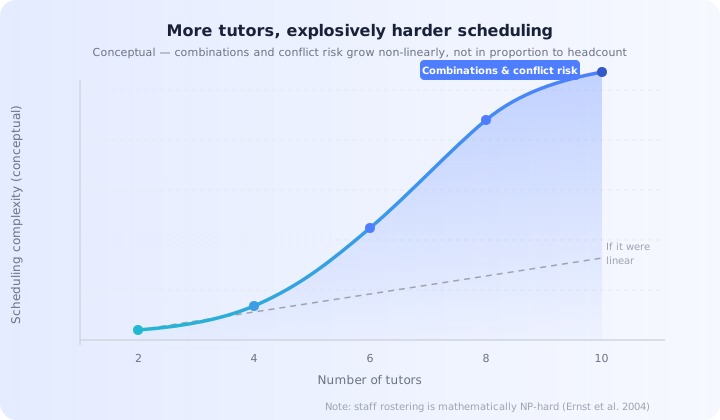
This is a structural problem, not a discipline problem. Scheduling ten tutors is not five times harder than two; it is combinatorially harder, and the solo-era tools (paper timetable, spreadsheet, group chat) fail in predictable ways as staff numbers grow.
This article covers the staff side: rosters, availability, who sees what. For parent-facing messaging, see our guide to outgrowing WhatsApp for parent communication.
The Setup: Growing Centres, Mostly Part-Time Staff
First, centres are adding staff. In Singapore, household spending on private tuition reached S$1.8 billion in 2023, up from S$1.4 billion in 2018, per a February 2025 Ministry of Education parliamentary reply. More classes mean more tutors per centre.
Second, tutoring staff are overwhelmingly part-time. Japan's Ministry of Economy, Trade and Industry surveyed the cram-school (juku) industry and found 327,547 workers across 46,734 establishments, with 71.9% employed as part-time or casual staff. The same figures work out to about 7.0 staff per establishment: exactly the two-to-ten-tutor range.
Part-time means fragmented availability: exam weeks, second jobs, weekday evenings only. Your roster reconciles all of it, every week.
What Actually Holds a Multi-Tutor Schedule Together
The centres that handle this well have structure, not superhuman owners: one roster, early confirmation, clear rules about who sees what. Each has evidence behind it.
1. One roster, readable by every tutor, on whatever device they carry
The most common failure mode is the schedule existing in several places at once: the owner's spreadsheet, a photo of a whiteboard, a message thread. Every copy is a chance for two tutors to believe two different things about the same Saturday.
The fix is boring and absolute: one shared calendar that is the schedule, not a description of it. In E-Space, tutors are added under the teacher role and see their own classes on the iOS or Android app or in the web console. A part-time tutor on a bus and the admin at a desk see the same truth.
2. Confirmed schedules, delivered early: notice period is what tutors quit over
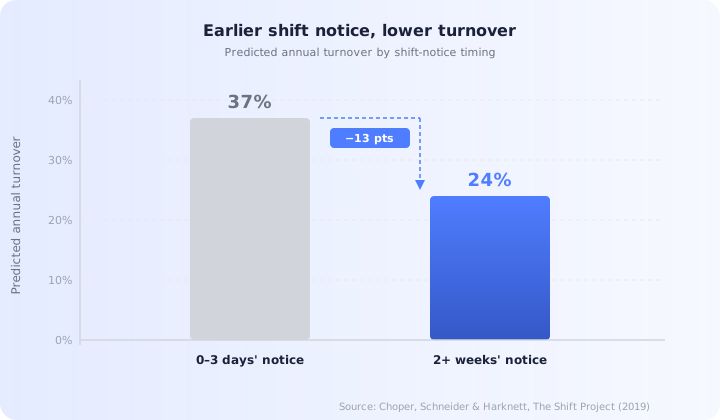
The strongest evidence in staff scheduling research is about advance notice, not software. The Shift Project's panel study of 1,725 hourly service workers (Choper, Schneider & Harknett, Uncertain Time, later published in ILR Review) found that short-notice scheduling significantly increases job turnover:
"In terms of predicted values, turnover was 37% among those with 0-3 days' advance notice against 24% among those with at least two weeks'."
Choper, Schneider & Harknett, Uncertain Time (The Shift Project working paper, October 2019)
In the same study, only 48.6% of workers received their schedules two or more weeks in advance; 20.8% had worked on-call shifts and 13.6% had experienced shift cancellations. Your part-time tutors live in this labour market. A centre that confirms rosters two weeks out and pushes the confirmation to each tutor's phone is competing for staff on the variable the research says matters most.
3. Roles that decide who sees what, and who gets told
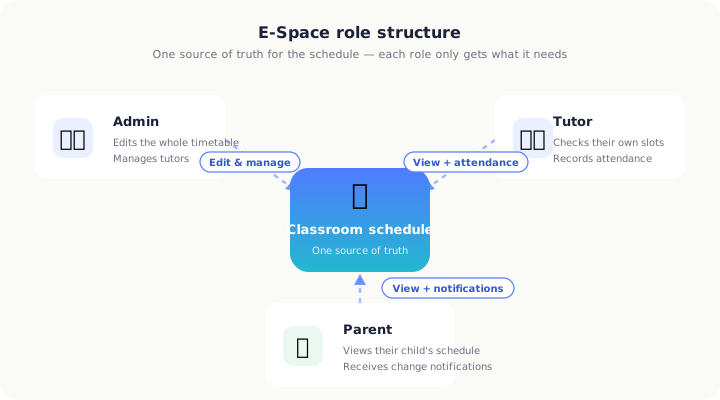
A spreadsheet has one view for everyone. A multi-tutor centre needs three: the admin needs the whole board; each tutor needs their own classes; parents need their child's schedule and nothing about staffing. One view for all three produces either information overload or information leakage.
A role structure solves this. E-Space separates admin (edits the roster, sees everything), teacher (sees and is notified about their own schedule), and student / guardian (sees their own classes). A schedule change notifies the people it affects instead of broadcasting staffing churn to everyone.
Three Facts That Complicate the Neat Story
Install a scheduling app, tutors stay, centre grows: the evidence does not support that story.
Fact 1: Building a roster is mathematically hard, and no app changes that
Staff scheduling with real constraints (tutor availability, subject fit, room limits, back-to-back rules) is an NP-hard optimisation problem (Ernst et al., surveying staff scheduling and rostering methods, and the wider nurse rostering literature). Even medium-sized instances cannot be solved to a guaranteed optimum in practical time. Software detects conflicts and makes the current state visible instantly; the judgment calls remain yours. Any tool promising to "automatically generate the perfect schedule" is overselling against the mathematics.
Fact 2: Digitising a bad habit doesn't retain tutors
The Shift Project data cuts both ways. What predicts turnover is operational habit (notice period, cancellations, on-call practices), not the presence of software; median annual turnover in that study's sector was around 50%. If you keep finalising the roster three days out and deliver the bad news through a nicer app, the 37%-turnover conditions are unchanged. The app is the delivery mechanism; the retention lever is the two-weeks-ahead confirmation rule.
Fact 3: More tutors and more sites do not automatically mean more profit
Kip McGrath Education Centres, an ASX-listed tutoring operator running 433 centres across Australia, New Zealand and the UK on A$30.1M revenue, exited its US operations in FY25 citing "unsustainable business models", booking a loss for the year (Annual Report 2025). If a listed operator can be beaten by the overhead of scale, a two-to-ten-tutor centre should assume the same physics: every added tutor adds recruiting, training, and coordination cost. Scheduling structure lowers that cost; it does not repeal it.
The Bottom Line
Multi-tutor scheduling is hard for structural reasons: the problem grows combinatorially, most of your staff are part-time, and predicted turnover runs 37% at 0-3 days' notice against 24% at two weeks or more. E-Space supplies the structural half: one shared roster, a teacher role so each tutor sees their own classes on their own phone, push notifications on changes, and separate views for admins and families. The two-week rule is yours to keep; the free plan has no time limit, so test it with your real roster and see whether the Saturday questions stop.
Tutors don't quit over the timetable. They quit over hearing about it three days before it starts.