
It's late afternoon, and the front desk phone rings: "Hi — has my daughter arrived yet?" For families where both parents work and no one can do drop-off, that call comes again and again. Did the child get to the center safely? Have they already left for home? For a parent, the most pressing question isn't the test score — it's "where are they right now?"
Your center already holds the one piece of information that answers it: the moment a student walks through the door. If you can push that "arrived" and "left" to the parent's phone automatically, the afternoon phone calls quiet down and trust compounds. This article covers why arrival alerts matter now, the limits of doing it by hand, and the trap of assuming that "more notifications" simply equals "more safety."
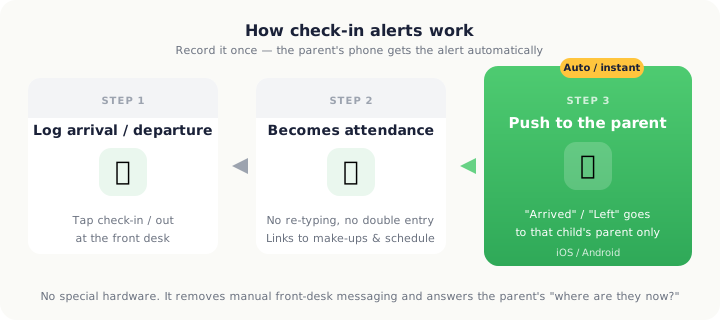 Record arrival and departure once — the parent's phone gets the alert automatically
Why Arrival Alerts Matter Now
Two working parents is the norm, and no one can do pickup
Dual-income households are now the majority, not the exception. On a weekday afternoon, far fewer families have a parent free to drive their child to a lesson and confirm they got there. The way parents used to reassure themselves — seeing it with their own eyes — has quietly disappeared for most. (In Japan, where E-Space is built, dual-income households reached roughly 15.9 million in 2025 versus about 5.3 million single-income households — about a 3-to-1 ratio, per the Statistics Bureau Labour Force Survey. The same structural shift holds across most developed economies.)
The risky window is the trip to and from
Public safety data consistently shows that incidents involving children cluster around the commute home in the late afternoon — the same window as the trip to and from a tutoring center. Japan's Ministry of Education, in its 2018 "Safety Plan for the School Commute," put it plainly: such incidents "are concentrated in the commuting hours, particularly the after-school window from 3 p.m. to 6 p.m." A reliable "arrived" and "left" from the one fixed point in that window — the center — is genuinely useful to a parent.
Community watch has gaps
The same plan acknowledges that volunteer watch programs are aging and short-staffed, and that the rise in dual-income families has thinned the adult eyes on the commute. The "solo stretch" near home is where coverage is weakest. That's exactly why a definite signal from the center — the arrival and departure point — carries weight.
The Limits of Doing Check-In by Hand
A paper sign-in sheet never reaches the parent
Ticking a student off on a paper roster keeps the information inside the room. The parent has no way to know their child arrived, so they fall back on calling. You have the record — it just never reaches the one person who most needs it.
Phone calls and manual texts: you either miss some or burn out
Run "text the parent when the child arrives" by hand and, on the busiest afternoons, some get missed. Try to do it reliably every time, and a tutor ends up stuck at the desk messaging parents one by one. Keep handling parent communication manually and it always tips one way: things slip, or your staff burns out.
It doesn't connect to attendance, so you enter everything twice
When your messaging tool and your attendance records live in separate places, you confirm arrival, message the parent, then copy the same fact into the register. Move attendance into an app and that check-in record becomes the attendance data and the parent alert in a single flow.
What Arrival Alerts Actually Solve
The point of a check-in alert isn't surveillance — it's removing the information gap between the center and the parent. The "arrived/left" that only the room used to know is now shared with the parent at the same moment. That alone changes a few things:
- Fewer afternoon phone calls. Parents can check "did they arrive?" themselves, which lightens the front desk.
- Faster awareness of an absence. If the arrival alert doesn't come at the expected time, both parent and center notice the no-show quickly.
- Trust compounds. "This center keeps an eye on my child" is a quiet force that keeps families from leaving.
"More Alerts" Isn't the Same as "Safer" — 3 Traps
If your takeaway so far is "then just notify on everything," pause here. The research on monitoring alerts is as clear about the downsides as the benefits.
Trap 1: Notification fatigue, and the flip to "I'm anxious when it doesn't come"
In a field study of an IC-tag child-safety system, the share of parents saying they'd find it "inconvenient to be without the system" rose from under half before adoption to over 70% after, and more than 90% said they felt "anxious when no message arrives" (Citizen Science Initiative Japan, "Possibilities and Challenges of IC-Tag Child Safety Systems"). An alert is a tool for reassurance — and, at the same time, a potential new source of anxiety. Narrow the alert types and design when they fire.
Trap 2: An alert is not safety itself
The same study notes a fundamental limit: a monitoring system "cannot actually help on the spot the moment danger appears." It also warns that leaning on the system's information can crowd out the real conversations and other precautions between parent and child. A check-in alert reports a fact — "arrived/left" — it does not guarantee the safety of the journey. Sharing that premise with parents prevents over-reliance.
Trap 3: Over-monitoring, plus cost and operational load
Being tracked at all times warrants care from a child-development standpoint — autonomy grows from some independence. And dedicated hardware like a GPS tracker carries a device cost plus a monthly fee; some municipal purchase subsidies explicitly exclude the monthly charge (e.g. Matsudo City, Chiba). "Hand out special hardware" leaves cost and operational load sitting on the center. Handling check-in through the center's own operation, without stepping into constant surveillance, is the realistic balance.
When It's Worth Adopting
If two or more of these apply, it's time to consider check-in alerts.
- ☐ Many families have two working parents and no one to do pickup, and you get "did they arrive?" calls.
- ☐ You record check-in on paper or in a spreadsheet, but can't share it with parents.
- ☐ You've been slow to notice an absence or a late arrival.
- ☐ You enter attendance and parent messages separately — double work.
Check-In Alerts in E-Space
E-Space ties together check-in records, parent alerts, and attendance in one app — with no special hardware to hand out.
- Check-in record → automatic push. Log a student's arrival or departure and a push goes to that child's parent only. No manual messaging at the desk.
- Integrated with attendance and scheduling. The check-in record becomes the attendance data and links to make-ups and scheduling. No double entry.
- Targeted notifications. Check-in, schedule changes, and announcements are sent by purpose — so you send only the alerts that matter to the people who need them, avoiding notification fatigue.
- iOS and Android. Parents receive alerts in the same app whether they're on iPhone or Android.
- Tied to withdrawal. Mark a student as withdrawn and the parent's access expires automatically — no lingering contacts and the data-exposure risk that comes with them.
| Plan | Monthly | Notes |
|---|---|---|
| Free | ¥0 | Core features at no cost |
| Basic | ¥2,980 | For mid-sized centers |
| Premium | ¥9,800 | More capabilities |
| Unlimited | ¥19,800 | No limits |
Takeaway: An Alert Is the Doorway to Reassurance — Design Decides Its Quality
Telling a parent that their child "arrived" and "left" is a concrete value a center can deliver in a world where two-income households are the norm and the after-school window is when incidents cluster. Paper rosters and manual messaging either never reach the parent or wear out your staff.
At the same time, "just notify and everyone's reassured" is a trap. Notification fatigue, the fact that an alert isn't safety, and the downsides of over-monitoring all argue for the same thing: send only the alerts that matter, when they matter. That design is what keeps parents' trust over the long run.
E-Space is free to start, no credit card. Try how check-in records and parent alerts actually work in your own center first.